Why AI Fails
The Leadership Discipline Behind the 5% Who Succeed
95% of AI initiatives fail to deliver value.
Get weekly AI leadership insights:
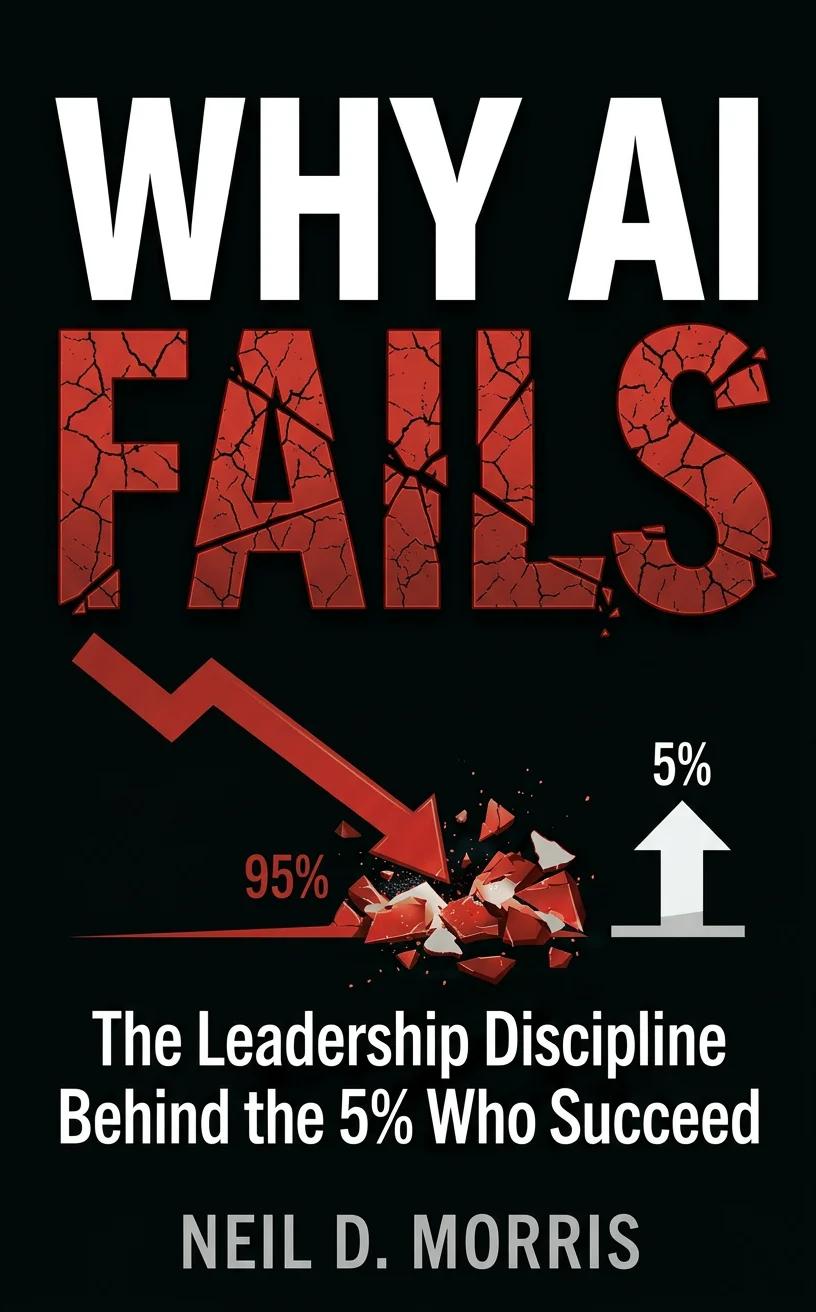
95%
of AI initiatives fail*
$40B
wasted annually*
7
leadership disciplines
5%
who get it right
Sources: MIT Sloan Project NANDA GenAI Divide Report (2025), McKinsey Global Institute State of AI Survey (2025), RAND Corporation (2024)
The Problem Isn't Technology
Every week, another AI initiative joins the pilot graveyard. Not because the technology failed—but because leadership discipline was missing from the start.
- Zombie pilots that never scale
- Vendor dependencies masquerading as capability
- Coalition collapse at the first obstacle
- Strategy by buzzword instead of North Star
The Solution Is Leadership Discipline
The 5% who succeed don't have better technology. They have better leadership discipline—seven foundational practices that compound over time.
- Strategic clarity before technology choices
- Capability that outlasts any vendor
- Pilots designed to scale or die
- Coalitions that survive setbacks
The Seven Pillars of AI Leadership™
Master these seven disciplines and you'll join the 5% who transform AI investment into lasting capability.
Strategic Clarity
Define your North Star before touching technology
Leadership Alignment
Build the coalition that makes transformation possible
Capability Building
Create permanent assets, not vendor dependencies
Pilot Discipline
Kill zombie projects before they multiply
Scale Strategy
Bridge the pilot-to-production gap
Risk Management
Enable progress while building guardrails
Continuous Evolution
Compound advantages through learning discipline
What Leaders Are Saying
Feedback from CISOs, CTOs, founders, and AI practitioners on LinkedIn
The gap between executive vision and operational execution is one of the reasons so many AI initiatives stall or fail. If leadership is the moat, then translation is the bridge. Organizations that will truly differentiate themselves won't just invest in executive clarity — they'll invest in building AI fluency at every level of leadership, especially among those closest to the work. That's where strategy becomes reality.
AI Governance & Ethical Systems Leader
Technology without leadership just scales the wrong habits. People and clarity are still what turn tools into real outcomes.
Founder & CEO, Constellation Search Group
You had me at data quality. I have rarely seen an AI initiative fail because of the algorithm. It's almost always the data, the people, or the process.
CISO | VP | AI & Technology Risk Expert
Your point on governance really stands out. AI doesn't just improve efficiency; it reshapes influence and decision rights. Without CEO-level sponsorship to reset incentives and expectations, even the best AI initiatives will struggle to move beyond pilots.
Chief Strategy Officer, Malogica Group
Early AI adoption rarely correlates with technical skill. It correlates with process friction and frustration. The real signal for leaders isn't who understands AI — it's where operational pain has been tolerated for too long.
CEO & Founder | Data-Driven Enterprise Architecture
So true, the real challenge in AI deployments is the people and processes, not the technology. Your 7-pillar framework perfectly illustrates this.
Founder & Principal Consultant | Microsoft Practice
I agree with this 100%. Culture and communication are always the root cause of failure.
Team Lead, Machine Learning
I have rarely read anything so succinct and to the point. It makes so much sense.
C-Suite Advisor for Professional Service Firms | AI-Enabled Leadership
I have been helping organizations in their transformation for over two decades. The ones who really transformed themselves successfully are the ones who did not run it as an IT project.
VP Strategy Execution | CIO Advisory | AI-ML | Digital Transformation
Your focus on execution over just the 'shiny' tech is the perspective we need to move the needle in 2026.
Director of Product GTM Operations & Commercialization
Successful AI transformations require a foundation of sound data quality, strong governance, and robust change management as pillars to prevent pilot purgatory.
Bootstrapped Founder | AI/ML Engineer
It is surprising to learn that 95% of AI projects fail. The AI frameworks that need to be built are the ones that focus on leadership, culture, and change management — the stuff that is hard to measure but makes all the difference.
Principal AI/Emerging Technology Leader
Shadow AI isn't a rebellion — it's demand signaling. When sanctioned tools are slow, generic, or disconnected from real work, people find their own solutions. Enablement beats prohibition, every time.
Chief Strategy Officer, Malogica Group
Your Personal AI Strategy Advisor
Get personalized guidance based on the Seven Pillars framework. Ask questions, get actionable advice, and accelerate your AI leadership journey.
- Contextual advice based on your assessment results
- Framework-backed recommendations from the book
- Real-world case study references
- Available 24/7 for strategic guidance
How do I build leadership alignment for our AI initiative?
AI Strategy Advisor
Building leadership alignment starts with three key actions from the Seven Pillars framework: First, create shared language around AI goals. Second, establish a cross-functional steering committee. Third, define shared KPIs that connect AI outcomes to business metrics...
What are the red flags I should watch for?
AI Strategy Advisor
Watch for these critical red flags: pilots running 6+ months without a go/no-go decision, success criteria that keep shifting, vendor dependency exceeding 60% of AI work, and "innovation theater" where activity substitutes for measurable outcomes...
Latest Insights
View All →The 5% Difference: What Winners Do Differently
The technology matters least. The same models are available to everyone. The difference is organizational execution.
The CFO's AI Question: Where's the Money?
Most AI business cases wouldn't survive a first-year finance student's scrutiny. Here's why CFO skepticism is justified.
When AI Projects Die: A Post-Mortem Field Guide
Every failed AI project leaves clues. The organizations that learn from failures are the ones that eventually succeed.
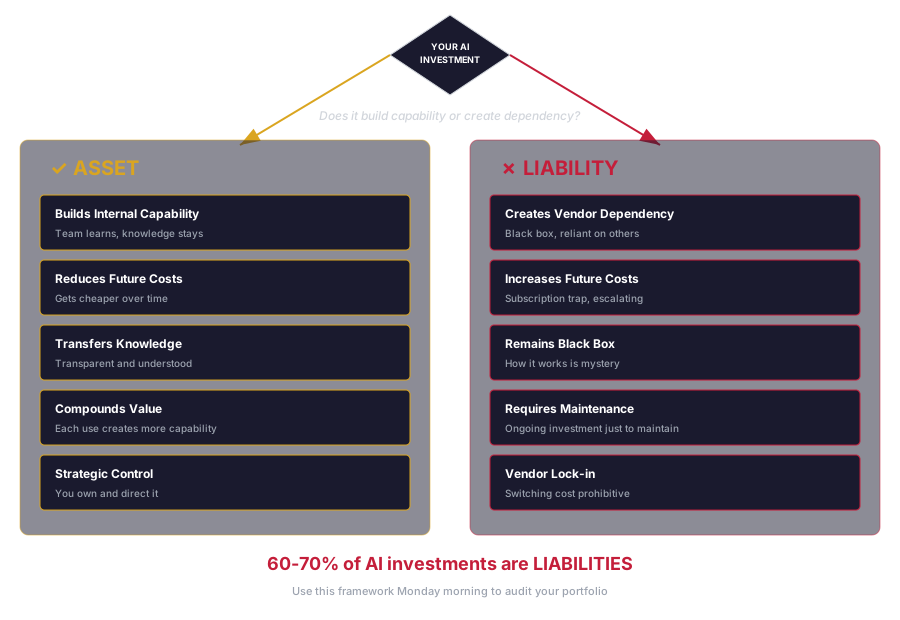
The Asset-Liability Framework
Is your AI investment building lasting capability or creating hidden dependencies? The Asset-Liability Framework helps you see clearly.
Where Does Your Organization Stand?
Take our free AI Leadership Readiness Assessment to discover your strengths, gaps, and the fastest path to joining the 5%.
Take the Free Assessment34 questions • Personalized results • Actionable recommendations

About Neil D. Morris
With more than 25 years leading IT across aerospace, defense, and regulated environments in both public and private organizations, Neil D. Morris now consults and advises leaders navigating AI transformation.
Having watched the same patterns of success and failure repeat themselves, he distilled those hard-won lessons into the Seven Pillars framework designed to give leaders the tools to avoid the 95% failure rate.
Read Neil's Full StoryReady to Join the 5%?
Stop watching AI investments disappear into the pilot graveyard. Get the framework that separates transformation leaders from technology tourists.